
Investment · AI & Semiconductors
AI Chip Investing 2026: 5 Proven Lessons From OpenAI’s $20 Billion Cerebras Mega-Deal
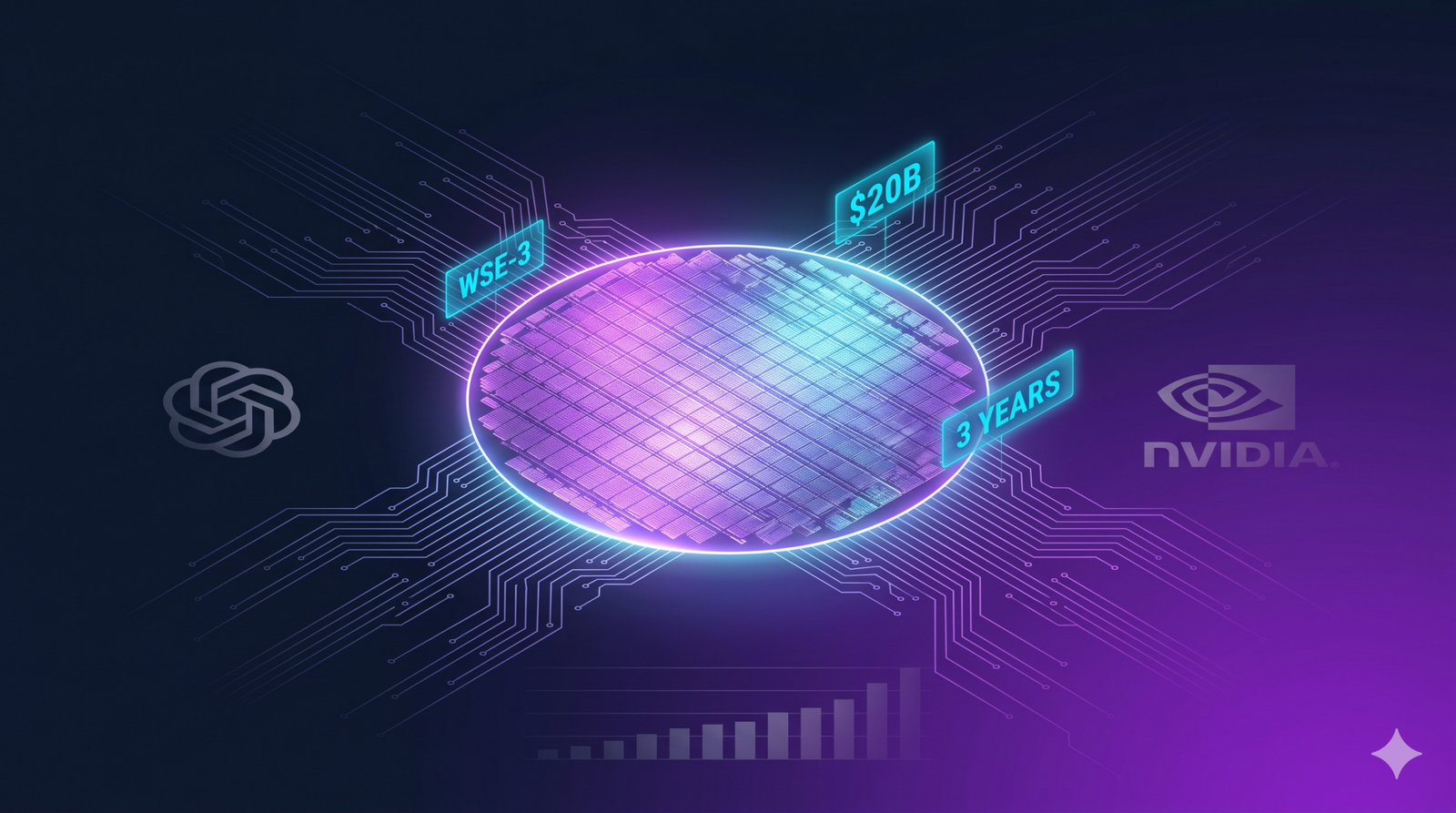
OpenAI just agreed to pay chip startup Cerebras Systems more than $20 billion over three years — doubling a deal announced in January and taking an equity stake that could reach 10% of the company. This is the largest non-Nvidia AI infrastructure contract in history. For young investors trying to understand ai chip investing, this deal rewrites the playbook. Here’s what it means, who the players are, and the 5 lessons you need.
$20B+ Mega-Deal
OpenAI will pay Cerebras $20B+ over 3 years for wafer-scale AI compute, plus $1B for data center funding. Total spending could reach $30B with warrants for up to 10% equity in Cerebras.
Breaking Nvidia Lock-In
This deal is a deliberate move to reduce OpenAI’s dependency on Nvidia GPUs. For the first time, a hyperscaler is betting billions on a fundamentally different chip architecture.
Cerebras IPO Incoming
Cerebras is targeting a Q2 2026 Nasdaq listing at $22-25B valuation. This OpenAI deal transforms the IPO narrative from “niche chipmaker” to “validated Nvidia alternative.”
1. The Deal: What OpenAI and Cerebras Just Agreed To
On April 17, 2026, The Information reported — and Reuters confirmed — that OpenAI has agreed to pay Cerebras Systems more than $20 billion to use servers powered by Cerebras chips over the next three years. This doubles the $10 billion agreement announced in January, when OpenAI contracted 750 megawatts of Cerebras computing capacity.
But the money is only part of the story. The deal structure reveals something more strategic. OpenAI will also provide Cerebras approximately $1 billion to fund the construction of data centers that will run OpenAI’s AI models. When you add it up — chip access, data center funding, and related commitments — OpenAI’s total Cerebras spending over three years could reach $30 billion.
In return, OpenAI receives warrants that could translate into up to 10% ownership of Cerebras. This is an unusual structure — a customer taking an equity stake in its supplier — that signals deep strategic alignment. OpenAI isn’t just buying compute; it’s investing in an alternative chip ecosystem.
💡 Why This Structure Matters
By taking equity in Cerebras, OpenAI ensures it benefits financially if Cerebras succeeds — while simultaneously reducing its dependence on Nvidia. It’s a hedge: if Cerebras chips deliver on performance claims, OpenAI gets cheaper compute AND equity upside. If they don’t, the $20B commitment still buys usable capacity. This is how institutional-grade deals are structured.
Cerebras could announce this deal as soon as Friday, April 18 — the same day it’s expected to unveil updated paperwork for its initial public offering on Nasdaq, targeted at a $22-25 billion valuation. The timing is not coincidental. A $20B+ contract from the world’s most prominent AI company is the ultimate IPO catalyst.
2. Who Is Cerebras (And Why Should You Care)
If you haven’t heard of Cerebras Systems, that’s by design — until now, it’s been a private company operating in the shadow of Nvidia. But the technology is genuinely different, and understanding it is essential for anyone interested in ai chip investing.
Founded in 2015 by Andrew Feldman and four other veterans of SeaMicro (which AMD acquired for $334 million in 2012), Cerebras took a bet that most chip engineers considered physically impossible: build a single processor from an entire silicon wafer — a dinner-plate-sized piece of silicon — instead of cutting it into hundreds of individual chips.
| Spec | Cerebras WSE-3 | Nvidia H100 | Difference |
|---|---|---|---|
| Chip Size | Entire 300mm wafer | 814 mm² die | 56x larger |
| Transistors | 4 trillion | 80 billion | 50x more |
| AI Cores | 900,000 | 16,896 CUDA | 53x more |
| On-Chip Memory | 44 GB SRAM | 80 GB HBM3 (external) | On-chip vs off-chip |
| Inference Speed (claimed) | 21x faster | Baseline | Cerebras claims lead |
The key architectural difference: Nvidia GPUs store data in external HBM memory chips, requiring data to travel across a relatively slow bus. Cerebras keeps everything on-chip, eliminating that bottleneck. This matters enormously for inference workloads — the process of running trained AI models to generate answers — which Deloitte estimates will account for roughly two-thirds of all AI computation by 2026.
In other words, the AI industry is transitioning from “training” (building the model) to “inference” (using the model). Nvidia dominates training. Cerebras is positioning itself to dominate inference. And OpenAI just bet $20 billion that this strategy works.
The Cerebras IPO: What to Know
Cerebras is targeting an April-May 2026 Nasdaq listing. Key facts for investors watching the IPO:
| Metric | Value |
|---|---|
| Target Valuation | $22–25 billion |
| Estimated Capital Raise | ~$2 billion |
| Lead Underwriter | Morgan Stanley |
| Last Private Round | $1.1B at $8.1B valuation (Sept 2025) |
| Estimated 2024 Revenue | ~$272M (H1 annualized, +245% YoY) |
| Key Risk | 87% of H1 2024 revenue from one customer (G42/UAE) |
| Strategic Investors | AMD, Fidelity, Coatue, Alpha Wave Global |
The OpenAI deal fundamentally changes the customer concentration risk — the biggest red flag in Cerebras’s S-1 filing. Going from “87% of revenue from one UAE client” to “massive multi-year contract with OpenAI” is a category transformation for IPO investors.
3. What This Means for Nvidia’s AI Chip Monopoly
Let’s be clear: Nvidia is not in trouble. The company remains the dominant force in AI computing, with its GPUs powering the vast majority of training workloads globally. TSMC just raised its revenue forecast, confirming strong AI chip demand. Nvidia’s upcoming “Rubin” GPU architecture, expected in late 2026, will incorporate many of the on-chip memory features that currently differentiate Cerebras.
But this deal signals something important: the era of Nvidia as the only option is ending. When the world’s most important AI company commits $20-30 billion to an alternative chip architecture, it validates the idea that the market is big enough — and the performance requirements diverse enough — for multiple architectures to coexist.
The competitive landscape now looks like this:
| Player | Architecture | Strength | Key Customer |
|---|---|---|---|
| Nvidia | GPU clusters + CUDA ecosystem | Training dominance, software moat | Everyone |
| Cerebras | Wafer-scale single chip | Inference speed, on-chip memory | OpenAI, G42 |
| AMD | Instinct MI series GPUs | Price-performance, open ecosystem | Microsoft, Meta |
| Google (TPU) | Custom ASIC | Integrated with Google Cloud | Internal + Anthropic |
| Custom ASICs | Broadcom/Marvell designs | Tailored for specific hyperscaler | Meta, Amazon |
For investors, the takeaway is nuanced: Nvidia remains a core holding for AI exposure, but the AI chip investment thesis is diversifying. The winners of 2027 may not be the same as the winners of 2024. As Reuters reported, this deal is explicitly designed to reduce OpenAI’s dependence on Nvidia’s supply chain.
4. 5 Proven Lessons for AI Chip Investing in 2026
Lesson #1: Follow the CapEx, Not the Headlines
Microsoft, Alphabet, Meta, and Amazon are collectively spending approximately $370 billion per year on AI-related capital expenditure. OpenAI alone is committing $20-30B to one chip supplier. When companies deploy capital at this scale, it tells you more about the future than any earnings call commentary. The lesson: track where the money is physically flowing — into data centers, chip contracts, and power infrastructure — rather than who’s winning the press cycle.
Lesson #2: Monopolies in Tech Always Get Challenged
Nvidia’s CUDA software ecosystem has been called an “unbreakable moat.” Intel’s x86 dominance was once considered equally unassailable — until ARM chips rewrote the mobile industry and Apple’s M-series rewrote personal computing. Now Cerebras is challenging GPU-cluster architecture at the chip physics level. No monopoly in technology is permanent. Smart investors maintain exposure to both the incumbent and credible challengers.
Lesson #3: The “Inference Flip” Changes the Investment Map
Training an AI model and running it are fundamentally different computing tasks. Training requires massive parallel processing (Nvidia’s strength). Inference requires fast, low-latency responses (Cerebras’s claimed strength). Deloitte estimates inference will account for two-thirds of all AI computation by 2026. If that shift accelerates, the companies optimized for inference workloads — not training — capture the next wave of spending. This is the “Inference Flip” and it’s the structural thesis behind both the Cerebras IPO and this OpenAI deal.
Lesson #4: IPO Hype ≠ Investment Quality
Cerebras has a $22-25B IPO target valuation on roughly $272M in annualized revenue. That’s a price-to-sales ratio of approximately 80-90x — extremely aggressive even by AI standards. The OpenAI contract de-risks revenue growth, but it also introduces massive customer concentration risk in a different form. Don’t confuse an exciting technology story with a reasonable entry price. The IPO pop may be impressive; the one-year return may not be.
Lesson #5: Invest in the Ecosystem, Not Just the Chip
Every AI chip needs a fabrication partner (TSMC), power infrastructure, cooling systems, data center REITs, and networking equipment. Often, the most reliable investment returns come from the picks-and-shovels layer rather than the chip companies themselves. TSMC (TSM) just raised its guidance. Equinix (EQIX) builds the data centers. Vertiv (VRT) provides cooling. Diversifying across the AI supply chain is a lower-risk way to capture the trend than betting on a single chipmaker.
For more on building a diversified tech portfolio, see our guide on index fund investing for beginners.
5. Interactive: AI CapEx Spending by the Numbers
How does the OpenAI-Cerebras deal compare to the broader AI infrastructure spending spree? This chart shows the scale of 2025-2026 AI capital expenditure commitments from major players — putting the $20B Cerebras deal in context.
6. Your AI Chip Investing Action Plan
The OpenAI-Cerebras mega-deal confirms that ai chip investing is entering a new phase — from “Nvidia or nothing” to a multi-architecture ecosystem. Here’s how to position yourself:
- 1. Don’t dump Nvidia. NVDA remains the center of gravity for AI computing. Its CUDA ecosystem, training dominance, and upcoming Rubin architecture make it a core holding. But recognize that the monopoly premium in its valuation may compress as alternatives emerge.
- 2. Watch the Cerebras IPO — but don’t chase it. IPO-day pops are exciting and usually painful for retail buyers. If you’re interested in CBRS, consider waiting 90-180 days post-IPO for the lockup expiration and first earnings report before evaluating.
- 3. Diversify across the AI supply chain. TSMC (fabrication), Broadcom (networking), Vertiv (cooling), Equinix (data centers), and Applied Materials (equipment) all benefit from AI capex regardless of which chip architecture wins.
- 4. Track the Inference Flip. Watch Deloitte and Gartner reports on inference vs. training workload mix. As inference spending grows, companies optimized for that workload — including Cerebras, Groq, and Amazon’s Inferentia — gain relative advantage.
- 5. Size your AI bets appropriately. The AI semiconductor space is high-growth, high-volatility. For most young investors, AI-specific stocks should be satellite positions (5-15% of portfolio) around a core of diversified index funds. Don’t let excitement override risk management.
The race for AI compute supremacy is just beginning. OpenAI’s $20 billion bet on Cerebras is a signal that the market is larger — and more architecturally diverse — than most retail investors realize. The winners of this cycle will be investors who understand the ecosystem, not just the biggest name in it.
For more foundational investment knowledge, read our guides on understanding P/E ratios and wealth management fundamentals.