
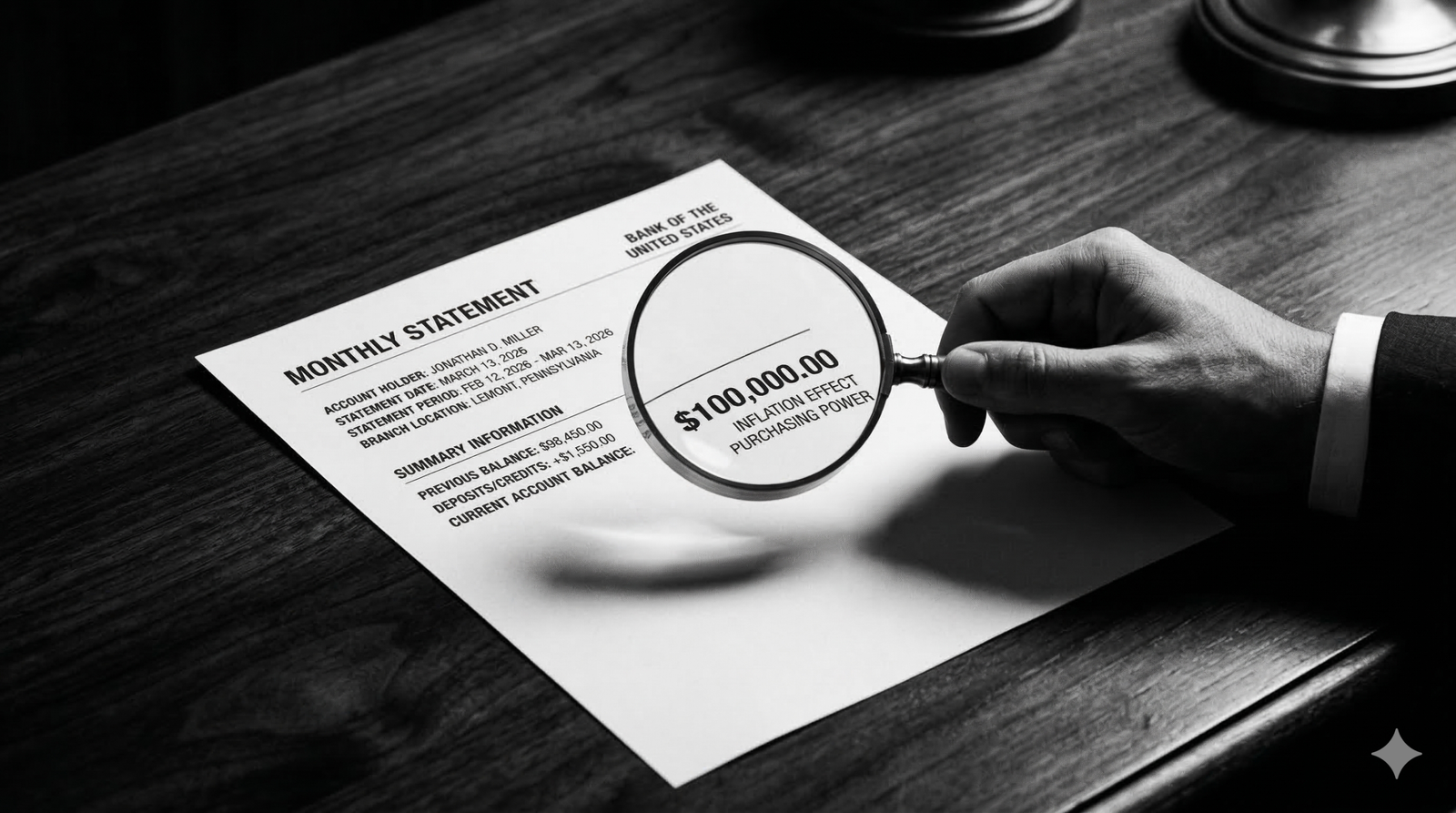
The $100k Salary Illusion: Why Six Figures is the New Trap in 2026
For decades, crossing the six-figure mark was the ultimate milestone of the American Dream. It meant financial security, a suburban home, and two cars in the driveway. But in the spring of 2026, earning $100,000 feels entirely different. It feels like treading water.
Table of Contents
There is a quiet panic rippling through the modern workforce. Professionals who have spent years grinding for promotions, finally securing a six-figure income, are checking their bank accounts at the end of the month and discovering almost nothing left. This mathematical cognitive dissonance is not the result of irresponsible spending or frivolous lifestyle creep. It is the manifestation of the 100k salary illusion. We are witnessing the unprecedented erosion of middle-class purchasing power, engineered by a relentless combination of structural inflation, paralyzed housing markets, and an outdated tax code.

To understand why earning six figures suddenly feels like living on the brink of poverty, we have to look past the nominal numbers on a W-2 form. The human brain is notoriously bad at adjusting for compounding inflation. When we think of $100,000, our minds anchor to what that money could buy in 2018 or 2019. But the dollars printed in 2026 simply do not contain the same economic kinetic energy.
The Erosion of Purchasing Power
The fundamental driver of the 100k salary illusion is the silent, cumulative effect of inflation. Since the beginning of the decade, the U.S. economy has experienced compounding inflation that has fundamentally rewritten the cost of existence. While year-over-year inflation may have cooled from its peak, prices have not gone down; they are simply rising at a slightly slower pace from a permanently elevated baseline.
According to the Bureau of Labor Statistics CPI data, it takes roughly $125,000 today to command the exact same purchasing power that $100,000 had just six or seven years ago. If your salary has grown from $85,000 to $100,000 over the last few years, you haven’t actually received a raise. In real, inflation-adjusted terms, you have taken a pay cut. Your standard of living has been downgraded while you were working harder than ever.
Macro Analysis: The Fixed Cost Squeeze
“The crisis isn’t that a cup of coffee costs a dollar more. The crisis is structural. Auto insurance premiums have spiked 20% due to the rising costs of vehicle parts. Property taxes are surging because home valuations skyrocketed. Childcare costs have become a second mortgage. These are non-negotiable, fixed expenses. A $100k earner cannot simply ‘budget’ their way out of a systemic increase in the baseline cost of human survival.”
The “Bracket Creep” and the Upcoming Tax Cliff
As your nominal salary inches upward to keep pace with inflation, you encounter another devastating mechanical flaw in the economy: the tax code. Earning exactly $100,000 pushes a single filer firmly into higher marginal tax brackets, meaning the government takes a larger slice of your income, even though that income buys less food, gas, and housing than it used to. This phenomenon is known as “bracket creep,” and it is the quietest wealth destroyer in the modern economy.
But the situation is about to become exponentially worse. At the end of 2026, the sweeping tax reductions introduced by the Tax Cuts and Jobs Act (TCJA) are scheduled to sunset. For the $100,000 earner, this is not a political talking point; it is a mathematical emergency. The reversion of the 22% bracket to 25%, combined with the halving of the standard deduction, means your take-home pay is poised to shrink dramatically starting January 1st.
Relying on old mental math to budget for next year will guarantee a cash flow crisis. To survive the expiration of the TCJA, you must forecast your exact net income right now. We strongly advise using our comprehensive 2026 Tax Calculator to see precisely how much deeper the IRS will reach into your paycheck. Ignorance of your impending tax liability is the final nail in the coffin of the 100k salary illusion.
The Degradation of the $100,000 Salary
Visualizing how compounding inflation has eroded the true buying power of a six-figure income over the last 7 years.
You have not lost money, but the money you have simply does less work. Earning $100k today offers the same lifestyle as earning $78,500 did before the decade’s financial turbulence.
Anatomy of a Modern Middle-Class Budget
To prove that the 100k salary illusion is not just theory, we must look at a brutal, real-world balance sheet. Let’s examine the monthly cash flow of Michael, a 34-year-old marketing manager living in a mid-tier American city like Austin or Denver.
The Six-Figure Squeeze
Michael, 34 • Single • Gross Income: $100,000/yr
Income & Taxes
- Gross Monthly Pay: $8,333
- Taxes (Fed, State, FICA): -$2,150
- 401(k) + Healthcare: -$680
- Net Take-Home: $5,503
Non-Negotiable Expenses
- Rent (1BR Apartment): -$2,100
- Auto Loan (7%) & Ins: -$750
- Groceries & Utilities: -$900
- Student Loan Payment: -$450
- Total Fixed Costs: -$4,200
From this $1,303, Michael must pay for gas, clothing, dining out, medical copays, car maintenance, and emergency savings. One flat tire or unexpected medical bill completely wipes out his discretionary income for the month. This is the reality of earning $100k in 2026.
Escaping the Illusion: A Strategic Pivot
Recognizing the 100k salary illusion is the first step toward reclaiming your financial autonomy. The rules of wealth creation have fundamentally changed. You can no longer rely on crossing a specific nominal income threshold to guarantee safety. Instead, you must ruthlessly optimize the income you have.
The modern survival strategy requires abandoning societal expectations tied to a six-figure income. It means driving a reliable, used vehicle instead of absorbing a $750 monthly car payment at 7% interest. It means aggressively pivoting to tax-free retirement vehicles, like the Roth IRA, to shield your future wealth from the inevitable post-TCJA tax hikes. Earning $100,000 is still an incredible achievement, but in 2026, it is no longer the finish line—it is merely the starting block for defensive, highly calculated financial planning.
The 2026 Wealth Preservation Matrix
1. Halt Lifestyle Creep
Reject the “I make $100k so I deserve this” mentality. Cancel unused subscriptions, cook at home, and refuse to finance depreciating assets like new cars. Treat your six-figure salary like it’s $75k.
2. Aggressive Tax Shielding
Maximize your pre-tax 401(k), HSA, and FSA accounts immediately. By artificially lowering your Adjusted Gross Income (AGI), you can dodge bracket creep and blunt the impact of the impending TCJA expiration.
3. Asset Accumulation
Do not hoard cash beyond your emergency fund. Inflation will eat it alive. Shift every remaining discretionary dollar into assets that historically outpace inflation, such as S&P 500 index funds or real estate.
Financial, Tax & YMYL Disclaimer
The content provided on FinanceWise is for informational and educational purposes only and should not be construed as professional financial, tax, or legal advice. The “Purchasing Power Analyzer” uses simplified macro-economic models based on blended historical CPI metrics to illustrate broad inflation trends and does not reflect your personalized inflation rate. Tax laws, including the impending expiration of the Tax Cuts and Jobs Act (TCJA), are subject to congressional changes. Always consult with a Certified Financial Planner (CFP®) or a Certified Public Accountant (CPA) before making significant decisions regarding your budget, investments, or tax strategies.
The Purchasing Power Analyzer
Input your current salary to mathematically reveal how cumulative inflation has eroded your true buying power compared to the pre-2020 economy.
The Mathematical Reality
* Calculation uses an estimated 21.5% cumulative erosion of purchasing power based on blended CPI metrics from 2019 to 2026. This illustrates the “100k salary illusion” where nominal numbers rise but actual lifestyle affordability drops.