
3 Strategies to Survive the 2026 Inflation Shock Today
Just as consumers thought the worst of the economic squeeze was over, a resurgence in consumer prices and persistently high interest rates are creating a new financial crisis. Discover the mathematical realities of the “higher for longer” economy and exactly how the middle class can protect their budgets.
Table of Contents
In early 2026, the financial headlines are dominated by a stark and uncomfortable reality: inflation is not dead. After a brief period of cooling, everyday Americans are once again feeling the vicious bite of rising prices at the grocery store, the gas pump, and in their utility bills. We have officially entered the 2026 inflation shock, a period characterized by “sticky” inflation and interest rates that simply refuse to drop back to the near-zero levels of the previous decade.

For the middle-class earner, this is the ultimate financial pressure test. A median-income family earning $80,000 a year is currently navigating an unprecedented economic gauntlet. Not only are the costs of basic necessities compounding at an alarming rate, but the cost of borrowing money—whether through credit cards, auto loans, or mortgages—remains prohibitively expensive. The Federal Reserve’s mandate to keep rates “higher for longer” to combat this resurgence means that hoping for a quick economic rescue is no longer a viable financial strategy. Today, we will dissect the anatomy of the 2026 inflation shock and provide actionable, mathematical strategies to fortify your household balance sheet.
1. Unpacking the Anatomy of the 2026 Inflation Shock
To survive the 2026 inflation shock, you must first understand why prices are rising again when we were told the crisis was over. The current wave of inflation is fundamentally different from the pandemic-era surge. It is not being driven by temporary supply chain bottlenecks or stimulus checks. Instead, it is deeply structural. Shifting global trade policies, new international tariffs, and a robust but constrained domestic labor market have created a “floor” under prices. Goods simply cost more to produce and import than they did three years ago.
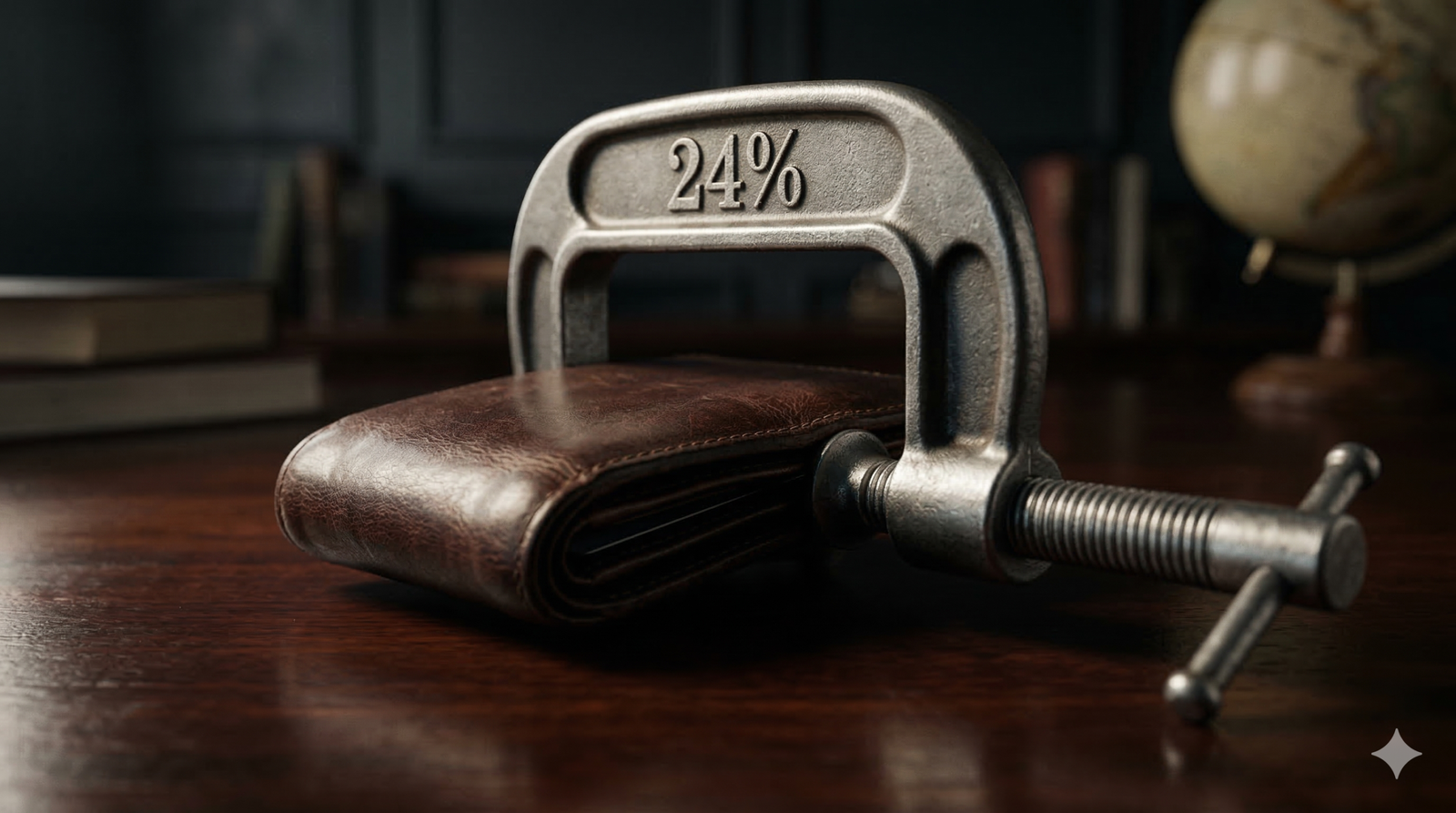
When core inflation refuses to drop to the Federal Reserve’s 2% target, the central bank cannot lower interest rates without risking a total devaluation of the currency. As a result, the Prime Rate remains elevated. If you carry variable-rate debt, such as a credit card balance at 24% APR, you are experiencing the bleeding edge of the 2026 inflation shock. Your paycheck is losing purchasing power at the supermarket, while simultaneously being drained by massive interest charges from the bank.
This structural shift is well-documented by macroeconomic data. According to the U.S. Bureau of Labor Statistics (BLS) Consumer Price Index reports, core services—including housing, insurance, and medical care—continue to exert immense upward pressure on household budgets, far outpacing average wage growth for middle-income earners.
Expert Insight: The Purchasing Power Drain
“Inflation acts as an invisible, highly regressive tax. If a household brings home $5,000 a month and experiences a localized 5% inflation rate on their core expenses, they must magically find an extra $250 every single month just to maintain their exact same standard of living. Because wages are historically slow to adjust, that $250 is almost always cannibalized directly from their monthly savings or retirement contributions.”
2. The Double Squeeze: Inflation Meets the Tax Cliff
As if rising prices were not enough, the 2026 inflation shock is occurring at the exact moment a massive legislative time bomb is set to detonate. The temporary tax cuts enacted in 2017 under the Tax Cuts and Jobs Act (TCJA) are scheduled to expire at the end of this year. This creates a terrifying “Double Squeeze” for the middle class.
Not only is your money buying less at the grocery store, but the IRS is about to take a larger percentage of your gross income. The 12% tax bracket will revert to 15%, and the 22% bracket will jump to 25%. Furthermore, the standard deduction will be nearly cut in half. For a median-income household, this means thousands of dollars in new tax liabilities exactly when their living expenses are peaking.
You cannot blindly navigate this year without knowing your exact mathematical exposure. If you are trying to budget for the rising costs of food and energy, you must also calculate how much smaller your take-home pay will be next year. We strongly urge every reader to input their current salary into our 2026 Tax Calculator. Understanding your imminent tax liability is the only way to accurately forecast your survival budget for the remainder of the year.
The “Double Squeeze” Effect
Scenario: Reallocation of a $5,000 monthly take-home budget before and during the 2026 shock.
The insidious nature of the 2026 inflation shock is that it doesn’t just make life harder; it systematically eradicates your ability to save and invest for the future.
3. Real-World Impact: Two Middle-Class Households
Macroeconomics can feel abstract until it hits your checking account. Let’s look at how the 2026 inflation shock mathematically impacts the daily lives of two very different, but completely average, American households making around $85,000 a year.
Case Study: The Variable Victim vs. The Fixed Fortress
John & Emma
The “Variable” Victim
- Housing: Renting ($2,200/mo)
- Credit Debt: $8,500 (24% APR)
- Cash Savings: $3,000 in Big Bank (0.1%)
Because John and Emma rent, their landlord raises their rent by 6% to keep up with inflation. The Federal Reserve’s refusal to drop rates means their credit card interest costs them $170 a month just to float. Their cash is earning nothing. The 2026 inflation shock forces them to put groceries on the credit card, compounding their debt death spiral.
David
The “Fixed” Fortress
- Housing: Fixed Mortgage 3% ($1,600)
- Credit Debt: $0 (Paid in full)
- Cash Savings: $20,000 in HYSA (4.8%)
David’s biggest expense (housing) is locked at 3% for 30 years; inflation cannot touch it. He has no variable-rate debt. Best of all, because interest rates are “higher for longer,” his High Yield Savings Account pays him nearly $80 a month in pure interest. He uses that free money to offset the rising cost of groceries. He survives effortlessly.
4. Actionable Defense Strategies for Today
You cannot control Federal Reserve policy, global supply chains, or congressional tax debates. But you can ruthlessly control your household balance sheet. To survive the 2026 inflation shock, you must pivot from a posture of passive spending to active financial defense.
The 2026 Household Defense Matrix
1. Annihilate Variable Debt
If you carry a credit card balance, you are paying 24%+ interest in a high-rate environment. Stop all discretionary spending immediately. Execute a 0% balance transfer or utilize the Debt Avalanche method to kill this debt before the end of the year.
2. Exploit High Yields
The only silver lining of the 2026 inflation shock is that banks are paying high interest. If your emergency fund is in a traditional bank earning 0.1%, move it to a High Yield Savings Account (HYSA) earning 4.5% to 5% today to offset grocery inflation.
3. Conduct a Core Audit
Cancel auto-renewals. Negotiate your internet bill. Switch to a low-cost MVNO cell phone provider (like Mint or Visible). You must artificially manufacture a 10% raise in your budget by cutting the fat to survive the impending tax hikes.
The 2026 inflation shock is frightening, but from an economic standpoint, it is a mathematical puzzle that can be solved with discipline. The worst financial mistake the middle class makes during a crisis is acting on emotion or doing nothing at all. Run your numbers, secure a high yield for your cash, eradicate toxic variable debt, and weather the storm.
Macroeconomic, Financial & YMYL Disclaimer
The content provided on FinanceWise is for informational and educational purposes only and should not be construed as professional financial, tax, or legal advice. The “2026 Household Inflation Analyzer” uses simplified mathematical models to demonstrate hypothetical impacts of local inflation and HYSA yields, which are highly subject to change based on Federal Reserve policies and market conditions. Past performance and historical economic trends do not guarantee future results. Always consult with a Certified Financial Planner (CFP®) or a Certified Public Accountant (CPA) before making significant changes to your household budget, debt repayment strategies, or investment allocations.
The 2026 Household Inflation Analyzer
Calculate exactly how the current wave of inflation is attacking your specific monthly budget, and see how moving your emergency fund to a High Yield Savings Account (HYSA) can mathematically offset the damage.
This is the exact amount you must cut from your budget this year just to break even if you take no defensive action.