
Devastating Oil Shock Crisis: Protect Your 2026 Budget Now
When global superpowers clash, the economic shockwaves don’t just echo in Wall Street boardrooms—they hit the gas pumps, the grocery aisles, and your retirement accounts. Here is a strictly financial breakdown of the geopolitical crisis and how everyday Americans can protect their wallets.
FinanceWise Editorial Board
Macroeconomics & Consumer Finance
Table of Contents
The 2026 Oil Shock, driven directly by the US-Iran conflict economic impact, is sending immediate, violent tremors through global commodity markets. While the geopolitical and humanitarian aspects of the crisis dominate the nightly news, the economic reality for the average American household is quietly becoming the most pressing domestic issue of the year.
We are not going to discuss the politics of the war. Instead, we are looking at the math. When a conflict threatens the Strait of Hormuz—a narrow waterway through which roughly 20% of the world’s global oil consumption passes—the price of crude oil skyrockets. As Brent crude surges past $110 a barrel, the financial architecture of the middle-class family faces an immediate stress test. If you earn $60,000 a year, a 40% increase in energy costs is not an inconvenience; it is a direct threat to your financial stability.

Global energy supply chains face severe disruption risks, directly accelerating domestic inflation.
The Regressive Tax of an Energy Crisis
To understand why this matters to you, we must understand how energy costs act as a “regressive tax.” A regressive tax is one that takes a larger percentage of income from low- and middle-income earners than from high-income earners.
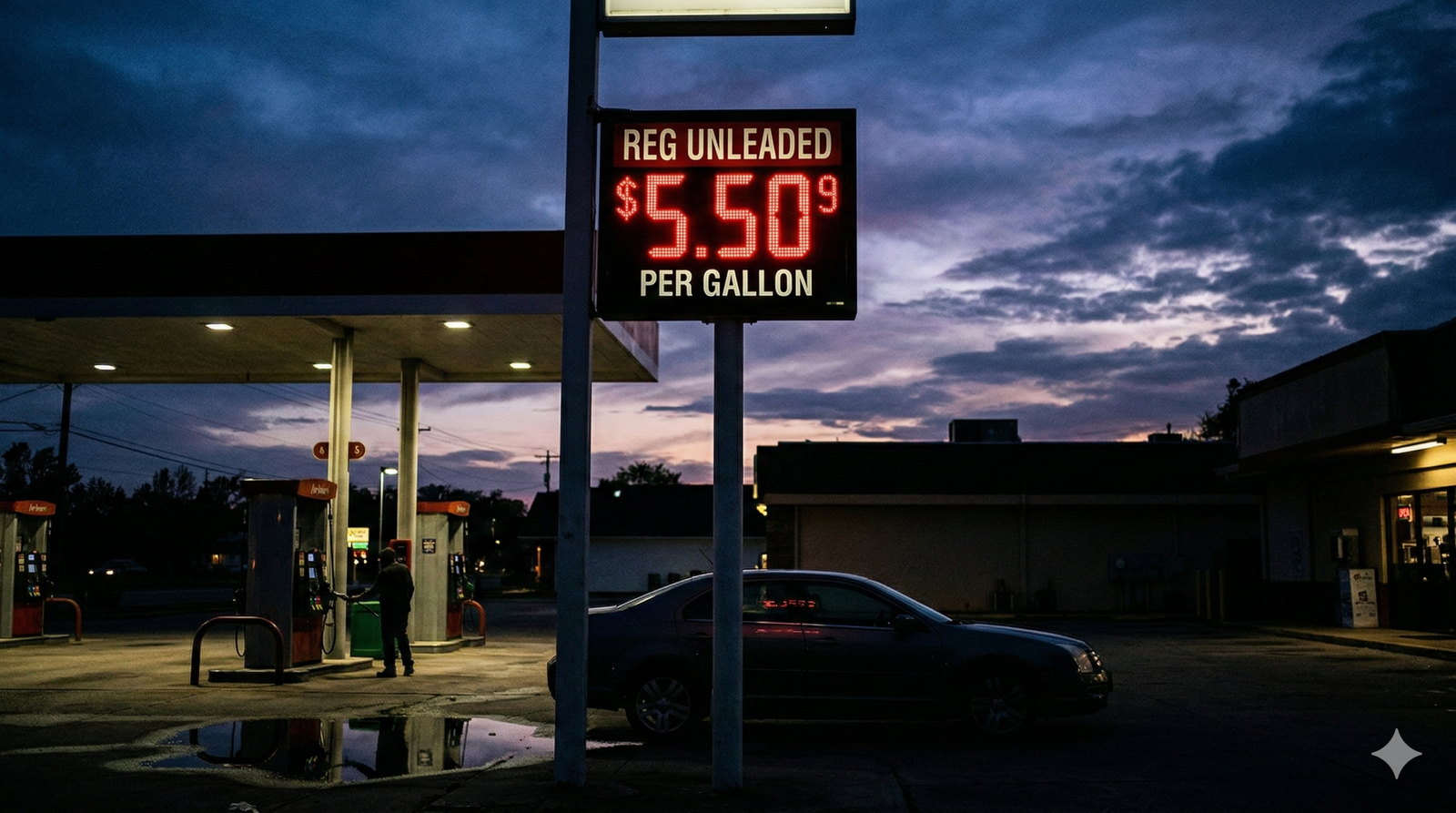
If gas goes to $5.50 a gallon, a corporate executive making $400,000 a year will barely notice the extra $60 it takes to fill their SUV. But for a teacher, a warehouse worker, or a nurse making $55,000 a year who commutes 40 miles a day, that extra $60 a week translates to over $3,100 a year in unbudgeted expenses. That money has to come from somewhere—usually by slashing savings rates, cutting back on discretionary spending, or, dangerously, leaning on high-interest credit cards.
Expert Insight: The Second Wave of Inflation
“The danger of an oil shock isn’t just at the gas pump. Diesel fuel powers the entire American supply chain. When it costs 30% more to fuel the 18-wheelers transporting food from farms to grocery stores, those costs are immediately passed to the consumer. Even if you drive an electric vehicle, your grocery bill is about to increase. This is the ‘second wave’ of inflation.”
The Middle-Class Budget Squeeze
How a $150/bbl oil shock reallocates a $4,000 monthly take-home budget.
Pure CSS Visualization: As energy and food costs expand, the first thing to be compressed is the household savings rate.
Real-World Impact: Two Average Households
To move beyond macroeconomic theory, let’s look at how this geopolitical crisis mathematically impacts the daily lives of two very different, but completely average, American households.
Case Study: The Commuter vs. The Remote Worker
Marcus, 34
Warehouse Manager ($55k/yr)
- Vehicle: Older F-150 (18 MPG)
- Daily Commute: 45 miles total
- Monthly Gas: $275 (Pre-Crisis)
With gas hitting $5.50/gal, Marcus’s fuel bill jumps to $480/month. Because he cannot work remotely, this is an unavoidable expense. The extra $205/month wipes out his entire monthly contribution to his Roth IRA.
Sarah & Tom
Teachers ($95k/yr Joint)
- Vehicles: One Hybrid (45 MPG)
- Daily Commute: Carpool (15 miles)
- Monthly Gas: $50 (Pre-Crisis)
Even at $5.50/gal, their gas bill only rises to $80/month. However, the “second wave” supply chain inflation pushes their $800 food bill to $920/month. They are shielded from the pump, but hit at the checkout counter.
What About Your 401(k)? The Market Reaction
Beyond your monthly budget, the geopolitical shock creates immediate volatility in the stock market. When war breaks out in an oil-producing region, the S&P 500 typically experiences a sharp, sudden drop as investors panic and move money into “safe haven” assets like gold, US Treasury bonds, or cash.
If you log into your 401(k) or IRA during the first few weeks of a conflict, you will likely see a sea of red. For a middle-class investor who has diligently saved $80,000 over ten years, seeing the balance drop to $68,000 in a matter of days is psychologically devastating. However, while you focus on optimizing your tax shields with advanced methods like the Mega Backdoor Roth strategy, you must not let a temporary oil shock derail your foundational contributions.
The 401(k) Crisis Decision Matrix
Panic Selling
Moving your 401(k) to “Cash” after the market has already dropped. You lock in your losses and guarantee you miss the eventual rebound.
Halting Contributions
Temporarily stopping your 5% contribution to free up cash for higher gas/grocery bills. Understandable, but you lose the free employer match.
Staying the Course
Ignoring the news, keeping your automatic contributions running. You are actually buying stocks “on sale” during the market dip.
Actionable Defense Strategies for Today
You cannot control foreign policy, but you can control your household balance sheet. Here are three immediate steps to insulate your finances from the 2026 oil shock:
- The ‘Gas-App’ Audit: Stop buying gas out of habit. Apps like GasBuddy can show price disparities of up to 40 cents a gallon within a two-mile radius. On a 15-gallon tank, that’s $6 saved per fill-up.
- Adjust Your W-4 Withholdings: If you typically get a large $2,000 tax refund every April, you are giving the government an interest-free loan. Use the IRS Withholding Estimator to adjust your W-4. Getting that money back into your paycheck now (an extra $160/month) can offset the pain at the pump.
- Yield Chasing for Cash: Ensure your emergency fund is not sitting in a traditional bank earning 0.1%. Move it to a High-Yield Savings Account (HYSA) earning 4.5% to 5% to help combat the loss of purchasing power.
Geopolitical shocks are frightening. But from an economic standpoint, they are temporary disruptions in long-term cycles. The worst financial mistake the middle class makes during a crisis is acting on emotion. Run your numbers, trim the discretionary fat from your budget, and weather the storm.
Macroeconomic & YMYL Disclaimer
The content provided on FinanceWise is for informational and educational purposes only and should not be construed as professional financial, investment, or macroeconomic advice. Geopolitical events, global energy prices, and supply chain disruptions are highly volatile and subject to rapid, unpredictable changes. The interactive Household Budget Stress Tester uses simplified, hypothetical mathematical models and standardized national averages that may not reflect your localized inflation rates or specific household tax situations. We strongly advise against making drastic portfolio changes—such as panic selling retirement assets or halting 401(k) contributions—based on short-term market shocks. Always consult with a Certified Financial Planner (CFP®) before altering your long-term investment strategy.
Household Budget Stress Tester
Calculate exactly how the current oil shock and supply chain inflation will impact your specific monthly budget.
This is how much extra cash you need to find in your budget every month just to maintain your current lifestyle.
+$0/mo