
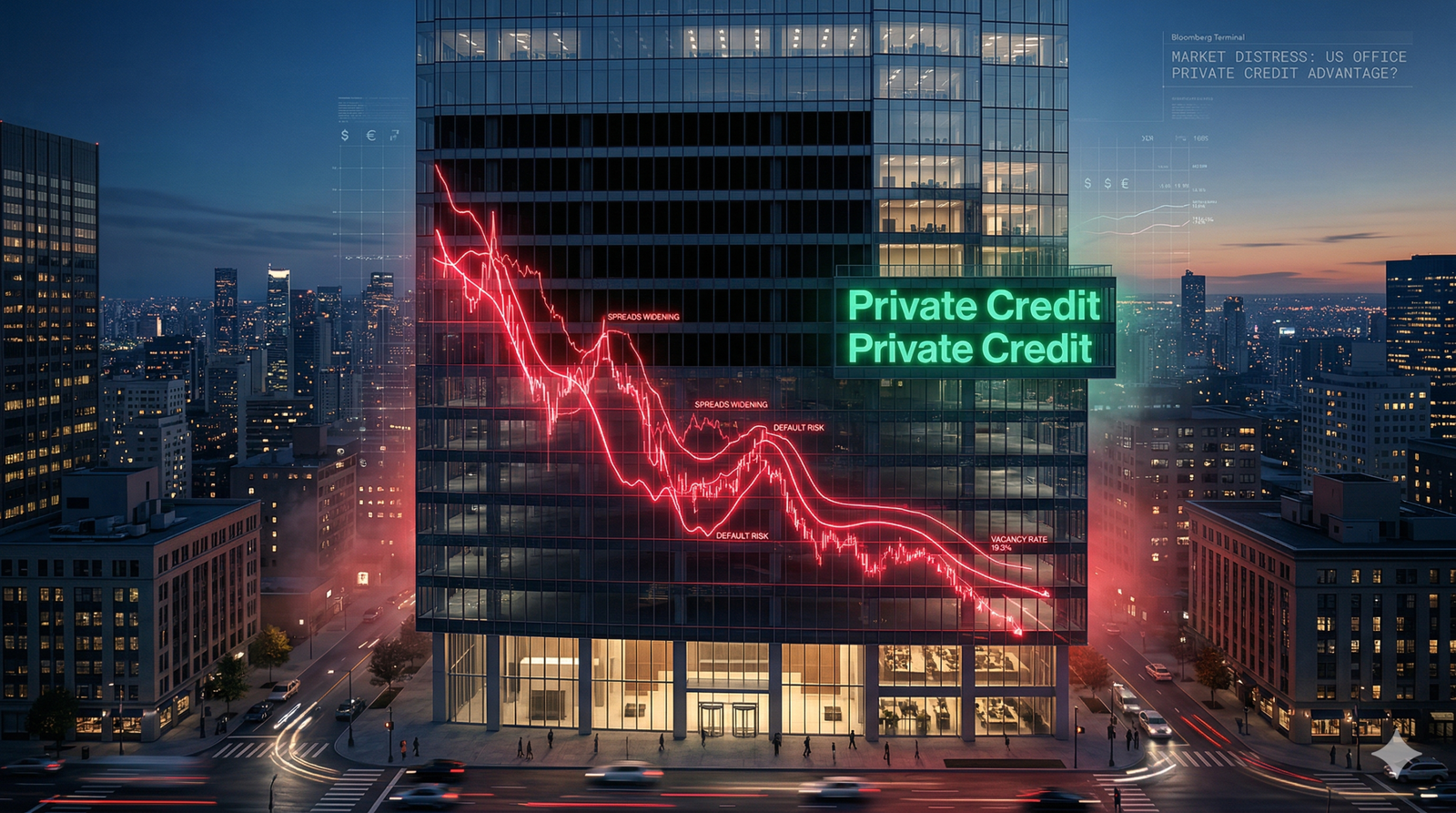
Commercial Real Estate Crash 2026: 3 Private Credit Strategies
The headlines from Bloomberg and CNN Business are painting a picture of systemic collapse as $1.5 trillion in commercial mortgages mature without refinancing options. Yet, institutional family offices aren’t panicking. They are stepping in as the new “Shadow Banks,” utilizing private credit to extract double-digit yields from distressed landlords.
If you open any major financial terminal today, the flashing red alerts all point to a singular, inevitable macroeconomic event: The Maturity Wall. The Commercial Real Estate Crash 2026 is no longer a localized issue affecting downtown office buildings in San Francisco or New York; it has metastasized into a systemic reckoning for regional banks and commercial landlords nationwide.
However, there is a profound disconnect between how retail investors and ultra-high-net-worth institutional investors are interpreting this crisis. While the general public sees crumbling valuations and dumps their public Real Estate Investment Trusts (REITs), elite family offices see the greatest debt-restructuring opportunity of the decade. They are systematically transforming the Commercial Real Estate Crash 2026 into a generational wealth transfer by replacing fleeing traditional banks with high-yielding “Private Credit.”
Table of Contents
The Private Credit Arbitrage Matrix
1. The Maturity Wall
Over $1.5T in 5-to-10 year commercial mortgages are coming due. With office vacancies exceeding 20%, buildings appraise for far less than their loan balances.
2. The Bank Retreat
Under strict new capital requirements, regional banks are refusing to refinance these balloon payments. The traditional credit spigot is completely dry.
3. Shadow Banks Enter
Private credit funds step in as the lender of last resort. They dictate punitive terms, capturing equity-like returns with the downside protection of senior secured debt.
1. The $1.5 Trillion Maturity Wall Explained
To fundamentally grasp the mechanics of the Commercial Real Estate Crash 2026, one must understand how commercial mortgages are structured. Unlike a 30-year fixed residential mortgage, commercial loans typically have terms of 5 to 10 years. At the end of that term, the landlord does not pay off the principal; they “refinance” the massive balloon payment with a brand-new loan based on the current value of the building and current interest rates.

According to recent analytical reporting by Bloomberg Real Estate, approximately $1.5 trillion of commercial real estate debt is coming due by the end of 2026. The vast majority of these loans were originated during the low-interest-rate euphoria of 2016 to 2019. Back then, an office building might have been valued at $100 million, generating robust rent, and servicing a $70 million loan at a 3.5% interest rate.
Today, the mathematics have violently inverted. Due to the permanent entrenchment of remote work, that same building now has a 25% vacancy rate. Net Operating Income (NOI) has plummeted. Consequently, the building’s appraised value has crashed from $100 million down to $60 million. When the landlord goes to the bank to refinance their $70 million balloon payment, the bank looks at the $60 million appraisal and issues a flat denial. The landlord is completely trapped, facing imminent foreclosure.
2. The Retreat of Traditional Regional Banks
Historically, regional and mid-sized community banks were the lifeblood of commercial real estate, holding roughly 70% of all CRE loans. However, these institutions are currently undergoing a severe regulatory and liquidity crisis.
Following the abrupt collapse of Silicon Valley Bank and Signature Bank, the Federal Reserve and other banking regulators have drastically tightened capital requirements (often referred to as Basel III Endgame regulations). Regional banks are effectively being forced to hoard cash and dramatically reduce their exposure to high-risk assets. They are not just refusing to issue new commercial loans; they are actively trying to dump their existing CRE portfolios at a discount to clean up their balance sheets. The traditional credit spigot for commercial real estate has completely run dry.
3. The Rise of “Shadow Banking” (Private Credit)
Nature abhors a vacuum, and Wall Street is no different. The Commercial Real Estate Crash 2026 has paved the way for the golden age of “Shadow Banking”—a term the media uses pejoratively, but which institutions simply refer to as Private Credit.
The Institutional Arbitrage
Private credit funds (managed by giants like Apollo, Blackstone, and specialized family offices) are not heavily regulated commercial banks. They draw their capital directly from high-net-worth investors, endowments, and sovereign wealth funds. Because they are not bound by stringent Federal Reserve deposit regulations, they can step in and lend money to desperate landlords who have been abandoned by traditional banks. Because they are the “lender of last resort,” they can dictate incredibly punitive, lucrative terms.
When a high-net-worth individual allocates capital into a Private Credit fund focused on distressed real estate, they are fundamentally altering their position on the capital stack. They are no longer the “landlord” (Equity) who suffers the first losses when property values drop. They become the “bank” (Senior Secured Debt). Even if the Commercial Real Estate Crash 2026 destroys the property’s equity value entirely, the Private Credit lender is first in line to either get paid massive double-digit interest or foreclose and take the prime real estate at a historic discount.
4. Execution: 3 Institutional Debt Strategies
As a core component of defensive investing in a turbulent macro environment, the ultra-wealthy are executing three highly specific debt strategies to capitalize on the maturity wall.

- 1. Distressed Debt Purchasing (Loan-to-Own): Private credit funds approach struggling regional banks and offer to buy their toxic commercial loans at 60 cents on the dollar. The bank takes the loss to clean its books. The private credit fund now holds the mortgage. If the landlord defaults, the fund forecloses and instantly acquires a Class-A building for a fraction of its replacement cost. This is the ultimate “Loan-to-Own” strategy fueled by the Commercial Real Estate Crash 2026.
- 2. Rescue Capital / Mezzanine Financing: A landlord needs $20 million to cover the shortfall on their refinancing balloon payment or risk losing their $100 million building. Traditional banks refuse to help. A private credit fund steps in with the $20 million “rescue capital,” but structures it as Mezzanine Debt. This debt carries exorbitant interest rates (12% to 15%) and often includes “equity kickers,” granting the lender a percentage of the building’s future profits.
- 3. Senior Secured Direct Lending: For high-quality assets (like multi-family housing or industrial logistics centers) that traditional banks simply don’t have the balance sheet to fund anymore, private credit steps in as the primary first-lien lender. They negotiate lower Loan-to-Value (LTV) ratios (e.g., lending only 50% of the property’s value instead of 75%), ensuring an immense margin of safety while collecting 9% to 11% yields tied to floating rates.
The Commercial Real Estate Crash 2026 is devastating for public REIT shareholders and highly leveraged landlords. But for those possessing liquid capital and the institutional foresight to shift from the equity side of the ledger to the senior debt side, the current crisis represents one of the most asymmetric risk-to-reward profiles in modern financial history.
Interactive: The Capital Stack Simulator
See the mathematical protection of acting as the “Bank.” Compare the portfolio survival rate of a Public Office REIT (Equity) versus Senior Private Credit (Debt) as property valuations collapse during the Commercial Real Estate Crash 2026.
Simulate the crash. Equity absorbs all losses first. Senior debt is protected until the property value drops below the loan amount (LTV barrier).
Loan-to-Value. A 60% LTV means the Private Credit fund only lent 60 cents for every dollar of property value.
Macroeconomic & Investment Disclaimer
The information provided in this article regarding the Commercial Real Estate Crash 2026 and private credit strategies is for educational and analytical purposes only. It does not constitute professional financial, investment, or legal advice. Private Credit and Shadow Banking funds are typically illiquid, unregulated, and restricted strictly to Accredited Investors and Qualified Purchasers. Default risks in mezzanine debt and distressed debt purchasing can result in total capital loss if underlying property values breach Loan-to-Value (LTV) covenants. FinanceWise is not a registered investment advisor. You must consult with a certified fiduciary (CFP®) or institutional wealth manager before allocating capital to alternative debt instruments.
References & Citations
- Bloomberg Real Estate News. “The Commercial Real Estate Maturity Wall.” Available at Bloomberg.com.
- Board of Governors of the Federal Reserve System. Financial Stability Reports and Basel III Endgame regulatory framework updates. Available at FederalReserve.gov.