
FinanceWise Editorial Team
Tax Strategy 2026 | Read Time: 14 min
Congratulations. You’ve worked hard, climbed the corporate ladder, negotiated your salary, and finally achieved a high-income status. However, this success comes with a frustrating catch: the IRS limits your ability to make direct retirement contributions. Fortunately, executing a Backdoor Roth IRA 2026 strategy is the ultimate legal loophole to bypass these limits and continue building tax-free wealth.
In 2026, if you are a single filer making over an estimated $165,000, or married filing jointly making over $245,000, the IRS explicitly forbids you from contributing directly to a Roth IRA. Just like that, the government attempts to lock you out of a lifetime of tax-free exponential growth.
But the ultra-wealthy don’t take “no” for an answer, and neither should you. The Backdoor Roth IRA 2026 maneuver is not an illicit scheme or a shady offshore tactic; it is a perfectly legal, IRS-sanctioned tax strategy that allows high-income earners to bypass the income limits entirely.
In this deep-dive masterclass, we will meticulously unpack the mechanics of this strategy, explore the catastrophic danger of the “Pro-Rata Rule,” provide a flawless step-by-step execution plan, and prove mathematically why keeping your money in a standard taxable brokerage account is a massive financial mistake. (If you haven’t mastered the basics yet, we highly recommend reading our Personal Finance Foundations Guide first.)
Why The Roth IRA is the Crown Jewel of Investing
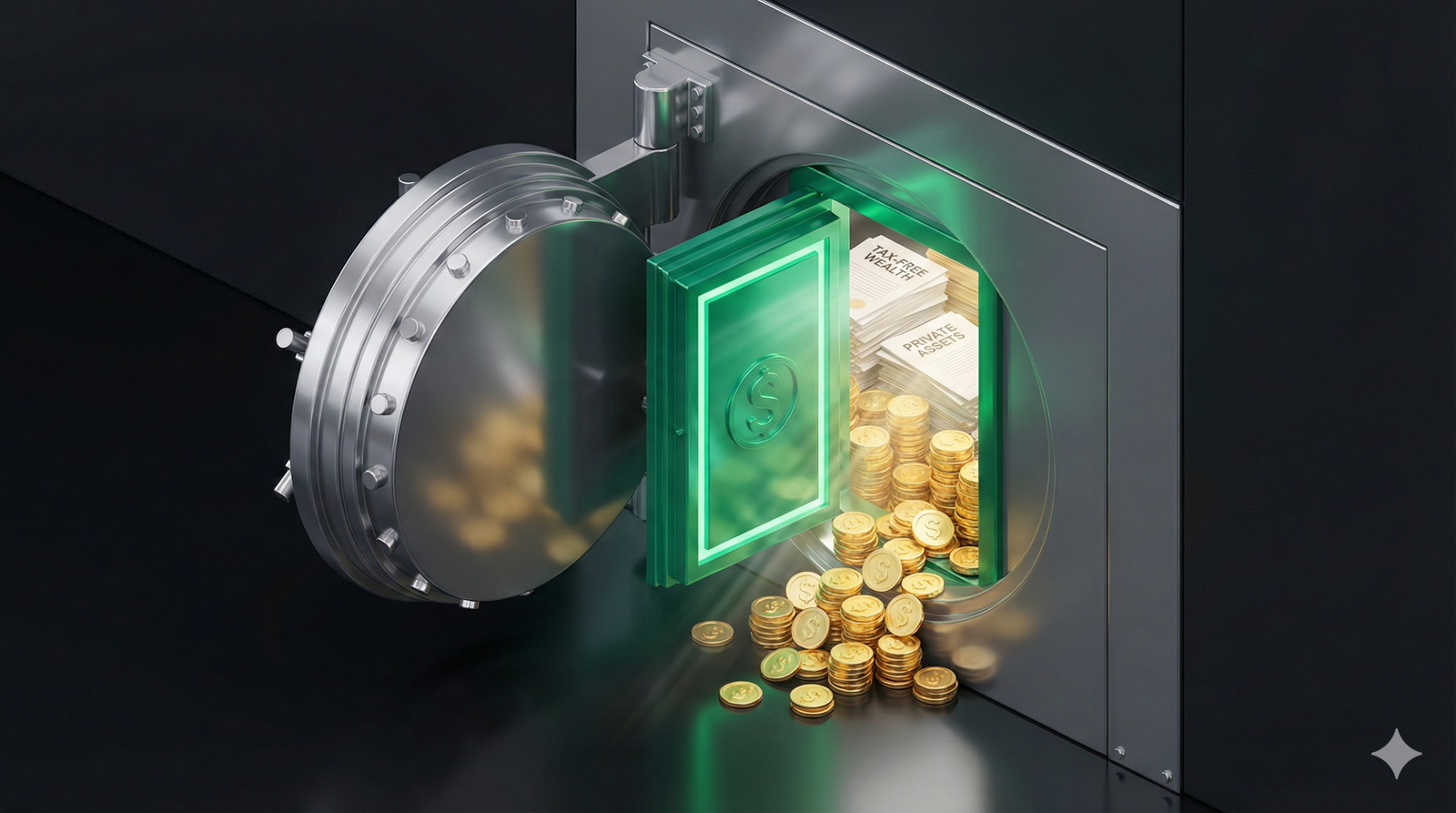
Before we discuss the “backdoor,” we must understand why the room inside is worth fighting for. The Roth IRA is unique because of its incredible tax treatment:
- Post-Tax Seed: You contribute money that has already been taxed (money from your checking account).
- Tax-Free Growth: Every dividend, every capital gain, and every compound interest multiple generated inside the account grows without a single cent of “tax drag.”
- Tax-Free Harvest: When you withdraw the money in retirement (after age 59½), the entire balance—both your original contributions and the massive earnings—is 100% tax-free.
Contrast this with a standard Taxable Brokerage Account. In a taxable account, you are taxed every year on dividends, taxed when you rebalance your portfolio, and heavily taxed when you eventually sell your assets in retirement. Over 30 years, this continuous taxation can easily siphon off hundreds of thousands of dollars from your net worth.
The Backdoor Roth IRA 2026 Mechanics: A Step-by-Step Guide
The term “Backdoor” is actually a colloquialism for a two-step process: making a non-deductible contribution to a Traditional IRA, and immediately converting that balance to a Roth IRA. Here is the exact, fail-proof sequence to execute a Backdoor Roth IRA 2026 conversion.
Step 1: Open a Traditional IRA
If you don’t already have one, open a Traditional IRA at a major brokerage (Fidelity, Vanguard, or Schwab). Ensure it has a $0 balance before you begin.
Step 2: Make a Non-Deductible Contribution
Transfer the maximum allowed amount (e.g., $7,500) from your checking account into the Traditional IRA. Crucial: Leave this money in cash/a settlement fund. Do not buy stocks or ETFs yet. Since your income is high, you will not claim a tax deduction for this contribution.
Step 3: Execute the Conversion
Wait a few days for the funds to fully clear and settle. Then, click the button in your brokerage portal to “Convert to Roth IRA.” Move the entire balance into your Roth IRA.
Step 4: Invest the Funds
Once the money is safely inside the Roth IRA, invest it into your chosen assets (like VOO or SCHD). The door is now shut behind you, and your wealth is growing tax-free.
The Danger Zone: Avoid the Pro-Rata Rule
The process above sounds remarkably simple. However, there is a massive landmine that blows up the tax strategies of thousands of high earners every year: The Pro-Rata Rule.
The IRS views all your Traditional IRAs (including Rollover IRAs from old 401ks, SEP IRAs, and SIMPLE IRAs) as one giant bucket of money. When you attempt a Backdoor Roth conversion, the IRS dictates that the conversion must be taxed proportionally based on the ratio of pre-tax (deductible) to post-tax (non-deductible) money across all your IRA accounts.
You have an old Rollover IRA with $92,500 of pre-tax money from a previous employer. You open a new Traditional IRA and deposit $7,500 of post-tax money for the backdoor strategy. Your total IRA balance is $100,000.
You attempt to convert just the $7,500 post-tax money to your Roth. Because 92.5% of your total IRA assets are pre-tax, the IRS forces you to pay taxes on 92.5% of the $7,500 conversion ($6,937 is added to your taxable income!). You have failed the strategy and created a massive tax bill.
How to Avoid the Pro-Rata Rule
To execute a clean, tax-free Backdoor Roth IRA 2026 strategy, your pre-tax IRA balance must be exactly $0 on December 31st of the year you do the conversion. If you have existing pre-tax IRAs, you have two options:
- The Reverse Rollover: Roll your pre-tax IRA money into your current employer’s 401(k) plan. 401(k)s do not count toward the Pro-Rata calculation. This “hides” the pre-tax money and clears your IRA balance to $0.
- Convert it All (Tax Hit): If the balance is very small, you can bite the bullet, convert the entire pre-tax balance to Roth, pay the income tax on it this year, and enjoy a clean slate for all future years.
The Tax Man Cometh: IRS Form 8606
Doing the conversion on your brokerage website is only half the job. You must report it to the IRS correctly. Failing to do so will result in the IRS taxing you twice on the same money.
When you file your taxes, you must include IRS Form 8606 (Nondeductible IRAs). This form tracks your “basis” in the IRA. It proves to the IRS: “Hey, I already paid income tax on this $7,500 before I put it in the Traditional IRA. Therefore, when I converted it to a Roth, I shouldn’t owe taxes on it again.”
A Note on the “Mega Backdoor Roth”
For the absolute highest earners, the standard $7,500 Backdoor Roth is just the appetizer. If your employer’s 401(k) plan allows for “After-Tax Contributions” and “In-Service Withdrawals,” you have access to the Mega Backdoor Roth.
This advanced strategy allows you to funnel up to an additional $46,000+ (based on 2026 limits) into your Roth IRA or Roth 401(k) every single year. It is the ultimate legal tax haven for tech executives, doctors, and highly compensated professionals.
Conclusion: Secure Your Financial Fortress
The tax code is written for those who study it. By taking a few extra clicks on your brokerage platform and understanding the Pro-Rata rule, you can legally shield hundreds of thousands of dollars in compounding growth from taxation. Do not let a high income exclude you from the best financial vehicle in America. Open the backdoor today.
🛡️ The FinanceWise Checklist
Do not execute a conversion until you confirm the following:
- Verify Your IRA Balance: Ensure you have exactly $0 in ALL pre-tax Traditional, SEP, or SIMPLE IRAs before December 31st to avoid the Pro-Rata tax trap.
- Settle the Cash: Contribute your post-tax money to the Traditional IRA, leave it uninvested, and wait 2-3 days for it to clear before converting.
- Invest After Conversion: Do not forget to actually invest the money once it lands in the Roth IRA. Cash sitting in a Roth loses to inflation.
- File Form 8606: Remind your tax preparer that you made a non-deductible contribution and converted it, so they file Form 8606 correctly.
Disclaimer: This comprehensive guide is intended for educational and informational purposes only. It does not constitute professional tax, legal, or financial advice. Tax laws are incredibly complex and subject to change. Always consult with a Certified Public Accountant (CPA) or a fiduciary financial advisor before executing complex tax strategies like the Backdoor Roth IRA.
Official Sources: [1] IRS Publication 590-A (Contributions to IRAs). [2] IRS Form 8606 Instructions.